
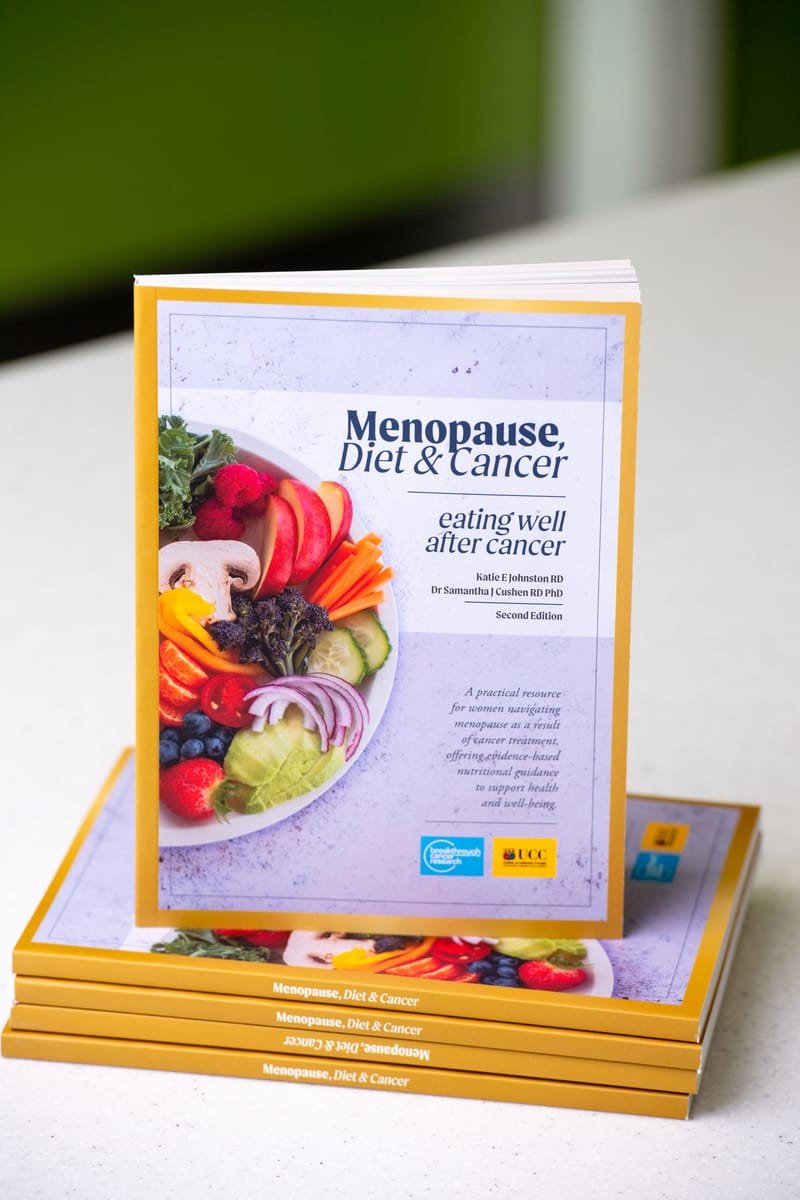
Menopause, Diet & Cancer is a free nutrition guide and recipe book for women whose menopause was triggered by cancer treatment. Breakthrough Cancer Research announced the second edition on 15 October 2026 and has distributed it to cancer centres across Ireland. It is written by University College Cork (UCC) dietitians.
The 164-page book is by Dr Samantha Cushen, Lecturer in Human Nutrition and Dietetics at UCC, and Dr Katie Johnston, an oncology dietitian and postdoctoral researcher at UCC. Both are in the Clinical Nutrition and Oncology Research Group at UCC and are registered dietitians with CORU, Ireland's health and social care regulator. The first edition was launched in May 2025 with the Irish Cancer Society. The charity Breakthrough Cancer Research has now taken over wider publication and distribution, according to its announcement.
- What: second edition of Menopause, Diet & Cancer: Eating Well After Cancer, 164 pages, free.
- Who it is for: women experiencing menopause as a result of cancer treatment, and the healthcare professionals supporting them.
- Authors: Dr Samantha Cushen, Lecturer in Human Nutrition and Dietetics, and Dr Katie Johnston, oncology dietitian and postdoctoral researcher, both CORU-registered dietitians at University College Cork.
- Origin: the LYSA trial, in which 200 women from Munster and Connacht took part, and the "What Women Want" focus groups.
- How to get it: free print copies via cancer centres and Breakthrough Cancer Research; the charity's website also offers a free download.
Why menopause after cancer needs its own guide
Chemotherapy, pelvic radiotherapy, surgery and hormone-blocking therapy can all bring on menopause early and suddenly. Breakthrough Cancer Research says the symptoms are often more intense than in a natural menopause, yet women affected by cancer are frequently overlooked in traditional menopause care and conversation.
The charity cites Ireland's Menopause after Cancer survey of 418 women. Half reported feelings of anxiety. Hot flushes and night sweats, disturbed sleep and fatigue were the symptoms women most wanted to be rid of.
When the first edition launched in May 2025, the authors told UCC that dietetic support for cancer survivors in Ireland was "virtually non-existent". In the new release, Dr Johnston says they set out to create the resource they found themselves reaching for in clinic, but which did not exist.
What is inside the second edition
The book has two parts. The first explains what nutrition can and cannot do for menopausal symptoms after cancer. The second turns that advice into recipes.
| Part | What it covers |
|---|---|
| Part 1: the science | Bone and muscle health; heart health; hot flushes and night sweats; urinary and gut health; brain health and fatigue; supplements |
| Part 2: the recipes | Breakfasts, light meals, mains, snacks, desserts and drinks, including alcohol-free options |
| Central tool | The Menopause Plate, the authors' own dietary guide inspired by Mediterranean eating |
| Recipe labels | Each recipe is marked, for example, as high in protein or fibre, a source of calcium, heart-healthy or ready in under 30 minutes |
Women affected by cancer and their families tested the recipes. Dr Johnston says women face an enormous amount of conflicting information about nutrition, supplements, weight and their long-term health after cancer. Part 1 includes a chapter on supplements.
The research behind the book: the LYSA trial
The guide grew out of the Women's Health Initiative "Linking You with Support and Advice" (LYSA) trial, led by University College Cork and registered as NCT05035173 on ClinicalTrials.gov. The Irish Times named Professor Roisin Connolly, a medical oncologist, and Professor Josephine Hegarty, chair of nursing at UCC, as principal investigators. The registry lists University College Cork as lead sponsor, with collaborators including the Irish Cancer Society, Breakthrough Cancer Research and the Sidney Kimmel Comprehensive Cancer Center at Johns Hopkins.
| Item | Detail |
|---|---|
| Participants | 200 women from Munster and Connacht treated for early-stage breast, cervical or endometrial cancer |
| Design | Randomised: a women's cancer survivorship clinic using online symptom reports, compared with usual follow-up |
| Intervention | Online symptom questionnaires every two months for 12 months; based on the answers, women were offered virtual nurse or dietetic consultations (The Irish Times) |
| Dates | Started 13 March 2021; primary completion 20 September 2023; registry marks it completed on 2 March 2026 |
| Funding | Primarily funded by the Irish Cancer Society (The Irish Times) |
In May 2026, The Irish Times reported that women in the digital care group had significantly better quality of life than those on standard follow-up. We could not find a peer-reviewed results paper yet, so the size of the benefit is not public. The paper also reported that Dr Johnston, as the trial's oncology dietitian, gave women personalised nutrition support.
What the authors and clinicians say
Dr Cushen said the response to the first edition took the team by surprise, with women, families and health professionals all asking for it. "Women want this information, they need it, and they should have access to it," she said. She thanked Orla Dolan, chief executive of Breakthrough Cancer Research, and her team for making it possible for the book to reach many more women. She added that good nutrition care after cancer should not depend on where a woman lives or which clinician she sees.
Dr Johnston said the team set out to write the resource they had reached for in clinic and found missing, and that women report returning to the book again and again. According to the release, the book has been welcomed by clinicians, and Jennifer Feighan, chief executive of the Irish Nutrition and Dietetic Institute (INDI), said its members look forward to using it in clinical practice around Ireland.
How to get a free copy
There are three routes, all listed on the Breakthrough Cancer Research guide page:
- Download: the full book is free to read online or save as a PDF.
- Printed copy: a free hard copy sent to your home; a postage charge applies.
- In person: free copies have been distributed to cancer centres, hospitals, clinics and cancer support centres across Ireland; ask your healthcare team or local cancer support centre.
The book does not replace individual advice. Breakthrough Cancer Research encourages everyone diagnosed with cancer to seek advice from a registered dietitian with oncology experience, or from their oncology team.
Frequently asked questions
Is Menopause, Diet & Cancer free?
Yes. The digital version is free to download, and printed copies are free apart from a postage charge.
Who wrote the book?
Dr Samantha Cushen, Lecturer in Human Nutrition and Dietetics at UCC, and Dr Katie Johnston, an oncology dietitian and postdoctoral researcher at UCC. Both are CORU-registered dietitians in the Clinical Nutrition and Oncology Research Group at University College Cork.
Is it only for women with breast cancer?
No. It is written for women experiencing menopause as a result of cancer treatment. The LYSA trial behind it included women treated for breast and gynaecological cancers.
What changed from the first edition?
The first edition was launched in May 2025, developed in partnership with the Irish Cancer Society, according to UCC. Breakthrough Cancer Research now publishes the 164-page second edition and has distributed it to cancer centres nationwide. A detailed list of content changes has not been published.
Can I use it instead of seeing a dietitian?
No. Breakthrough Cancer Research says the book is not a replacement for advice from a healthcare professional.
Outlook
The book is an example of an Irish clinical trial producing a free, practical resource that reaches patients directly. The next step to watch is the full publication of the LYSA results, which would show how much the survivorship clinic model, including dietitian support, improved women's quality of life. Dr Cushen says more needs to be done to build dietetic services that meet women where they are; the guide fills part of that gap, not all of it.
Note: the details of the LYSA trial (design, participants, dates, funding and reported results), the first edition and HSE guidance come from the other public sources listed below, not from Breakthrough Cancer Research's announcement.
Sources
- Breakthrough Cancer Research: New recipe and nutrition guide for women facing menopause after cancer (press release dated 15 October 2026)
- Breakthrough Cancer Research: Menopause, Diet & Cancer guide page
- ClinicalTrials.gov: The LYSA (Linking You to Support and Advice) Trial, NCT05035173
- The Irish Times: New survivorship trial boosts cancer recovery among women (May 2026)
- University College Cork: New resource launched for women navigating menopause and diet after cancer (May 2025)
- Irish Examiner: Book details advice for cancer patients (May 2025)
- Roscommon People: Free nutrition guide for women facing menopause after cancer (October 2026)
Photos: Breakthrough Cancer Research, supplied with the press release and used for editorial coverage.