
Ireland's medicine spending per person was USD 807.4 in 2024, adjusted for price levels, which is exactly the EU median and 2.9% below the OECD median, OECD figures show. Medicines took 10.2% of Irish health spending, one of the lowest shares in the OECD, and the share has fallen every year since 2016.
The figures come from OECD Health Statistics, compiled by Airmid Éireann, the open-data engine of Priya Life Science. They cover retail medicines, those dispensed by pharmacies or bought in shops, not drugs given in hospitals.
- Per person: USD 807.4 in 2024 at purchasing power parity, 14th of 27 EU countries and 18th of 32 OECD countries.
- Share of health spending: 10.2%, against an OECD median of 13.3%. Only five OECD countries had a lower share.
- Ten-year change: after inflation, spending per person rose 2.4% from 2014 to 2024. The median OECD country rose 12.9%.
- Who pays: government schemes paid 79.4%, the third highest share in the OECD.
- Cross-check: the Central Statistics Office (CSO) gives the same 2024 total, €3,710 million.
How does Ireland compare per person?
Purchasing power parity (PPP) adjusts for differences in price levels, so the figures can be compared across countries. All 27 EU countries reported 2024 data. Ireland ranks 14th, so its figure is the EU median. Germany is highest at USD 1,338.1 and Denmark lowest at USD 542.9. Across the 32 OECD members with 2024 data, the median is USD 831.2 and Ireland ranks 18th. The United States is highest at USD 1,752.0.
| Country | USD per person (share) |
|---|---|
| Germany | 1,338.1 (14.0%) |
| Malta | 1,090.8 (18.8%) |
| Bulgaria | 1,078.9 (28.8%) |
| Greece | 1,016.6 (26.8%) |
| Austria | 969.1 (10.9%) |
| Lithuania | 961.2 (21.9%) |
| Slovenia | 954.4 (17.7%) |
| Italy | 953.6 (17.9%) |
| Luxembourg | 876.1 (10.7%) |
| Slovak Republic | 870.8 (22.2%) |
| France | 851.1 (11.4%) |
| Belgium | 850.5 (10.5%) |
| Spain | 819.1 (14.9%) |
| Ireland | 807.4 (10.2%) |
| Cyprus | 791.8 (16.7%) |
| Romania | 773.8 (25.2%) |
| Hungary | 764.7 (22.9%) |
| Sweden | 755.5 (9.6%) |
| Finland | 749.4 (11.1%) |
| Latvia | 736.2 (19.6%) |
| Czechia | 701.4 (13.5%) |
| Portugal | 684.4 (12.7%) |
| Croatia | 637.8 (18.1%) |
| Poland | 637.3 (14.7%) |
| Estonia | 563.9 (14.3%) |
| Netherlands | 551.8 (6.3%) |
| Denmark | 542.9 (7.3%) |
A low figure does not always mean fewer medicines. The OECD says Denmark's low retail spending reflects the widespread supply of medicines in hospital and outpatient settings, which are not counted here.
Why is the share of health spending so low?
Medicines took 10.2% of Ireland's current health spending in 2024. The OECD median was 13.3% and the EU median 14.7%. Ireland ranks 27th of 32 in the OECD and 24th of 27 in the EU. Only Costa Rica, Sweden, the United Kingdom, Denmark and the Netherlands were lower.
Part of the reason is that Ireland's total health spending is high. Dividing medicine spending per person by the share gives implied health spending of about USD 7,900 per person, against an OECD median of about USD 5,730, ranking Ireland 9th of 32. This is our derived figure.
Our reading: Irish medicine spending per person is ordinary for Europe, but it sits inside a large health budget, so it looks small as a share.
How has Irish spending changed over time?
In cash terms, retail medicine spending rose from €2,410.8 million in 2014 to €3,710.1 million in 2024. Per person, in current US dollars at PPP, it rose 48.5%.
Being at the EU median is new. Compared with the median of the other EU countries reporting each year, Ireland spent more per person in every year from 2014 to 2022: 16.0% more in 2014 and 7.7% more in 2022. The gap fell to 4.8% in 2023 and 0.2% in 2024.
Most of the 48.5% rise reflects price changes: at constant 2020 prices, spending per person went from USD 582.7 to USD 596.9, a rise of 2.4%. The median change across 31 OECD countries with both years was 12.9%, and Ireland ranks 23rd of 31.
The share of health spending peaked at 16.5% in 2006, was 13.0% in 2014 and has dropped every year since 2016. The 2024 figure is the lowest since 1983, when it was 10.1%. Across 31 OECD countries with both years, the median share fell from 15.8% in 2014 to 13.5%.
| Year | USD per person (share) |
|---|---|
| 2004 | 439.0 (15.7%) |
| 2009 | 584.0 (15.1%) |
| 2014 | 543.7 (13.0%) |
| 2019 | 624.5 (12.0%) |
| 2024 | 807.4 (10.2%) |
This suggests that pricing policies and wider use of generics, which the OECD names as reasons retail spending has trailed other health services across its members, may also apply in Ireland. The data cannot show which policy mattered most.
Who pays for medicines in Ireland?
Government and compulsory schemes paid €2,946.6 million, or 79.4%, in 2024. Households paid €763.5 million out of pocket, 20.6%, or USD 166.2 per person. Across 31 OECD countries with a breakdown, the median government share was 58.8%. Only Germany (83.2%) and France (81.8%) were higher. Ireland had the third lowest out-of-pocket share of 32.
What the figures include and leave out
The indicator is OECD health function HC.5.1, "pharmaceuticals and other medical non-durable goods": prescription and over-the-counter medicines bought outside hospital, including wholesale and retail margins and VAT. Medicines used during hospital or day-case treatment are counted as part of that care. The OECD notes that across 15 member countries, such non-retail medicines were 25% of total pharmaceutical spending in 2023.
The dataset has no prescribed and over-the-counter split for Ireland, so the total also includes items such as first aid kits and syringes. The OECD says this can overstate spending by 5 to 10%. Ireland's figures carry no OECD flags. Finland's 2024 value is provisional, Korea and Lithuania have a break in series, and Chile's definition differs. Six OECD members have no 2024 value and are left out: Australia and Israel (latest 2023), Norway (2022), Colombia (2017), New Zealand (2007) and Türkiye (2000).
We do not use shares of GDP. The CSO puts Irish current health spending at 6.5% of GDP in 2024 but 11.3% of modified gross national income (GNI*), an alternative measure it publishes for Ireland. Our reading: with a gap that wide, ratios to Irish GDP make spending look smaller than it is.
How to check these numbers
The source is the Airmid Éireann dataset oecd_pharma_spending (CSV), from OECD dataflow DSD_SHA@DF_SHA, retrieved 9 November 2026. Filters: function_code HC51, financing_code _T. Per person figures use unit_code USD_PPP_PS at current prices; real change uses constant prices (base year 2020); shares use PT_EXP_HLTH; financing shares divide HF1 and HF3 by _T in national currency (XDC, current prices). Comparison year: 2024. OECD means the 38 members, EU the 27 member states. Medians are unweighted.
The cross-check uses the Airmid dataset cso_health_accounts (CSV): table SHA11, function HC.5.1, all providers, 2024, against total current spending of €36,302 million in table SHA10, which also gives 10.2%. Of the €3,710 million, €3,627 million went through retailers and €69 million through hospitals. Both files matched the SHA-256 checksums in the Airmid catalogue. The analysis script is available on request. For spending on individual medicines in England and the United States, see our drug spending tracker.
Frequently asked questions
How much does Ireland spend on medicines per person?
USD 807.4 per person in 2024, at purchasing power parity, for medicines bought outside hospital.
Does Ireland spend more on medicines than other countries?
Per person, it is mid-table in the EU and slightly below the OECD median of USD 831.2. As a share of health spending, it is among the lowest.
Are hospital medicines included?
No. Medicines given in hospital are counted as hospital care, so countries that supply many medicines through hospitals, such as Denmark, look lower.
Outlook
Irish figures for 2025 are not yet in the dataset, although eight OECD members, including Denmark, France and the Netherlands, already report them. The open question is whether Ireland's share keeps falling. Priya Life Science will update the comparison when Irish 2025 data appear.
Sources
- OECD (2026), Health expenditure and financing (OECD Health Statistics, System of Health Accounts), dataflow DSD_SHA@DF_SHA (accessed on 2026-11-09), compiled by Airmid Éireann
- OECD, Pharmaceutical expenditure, Health at a Glance 2025, 13 November 2025
- Central Statistics Office, System of Health Accounts, tables SHA07, SHA10 and SHA11, updated 17 June 2026, CC BY 4.0
- Airmid Éireann, dataset catalogue with field definitions, licences and checksums, release of 9 November 2026
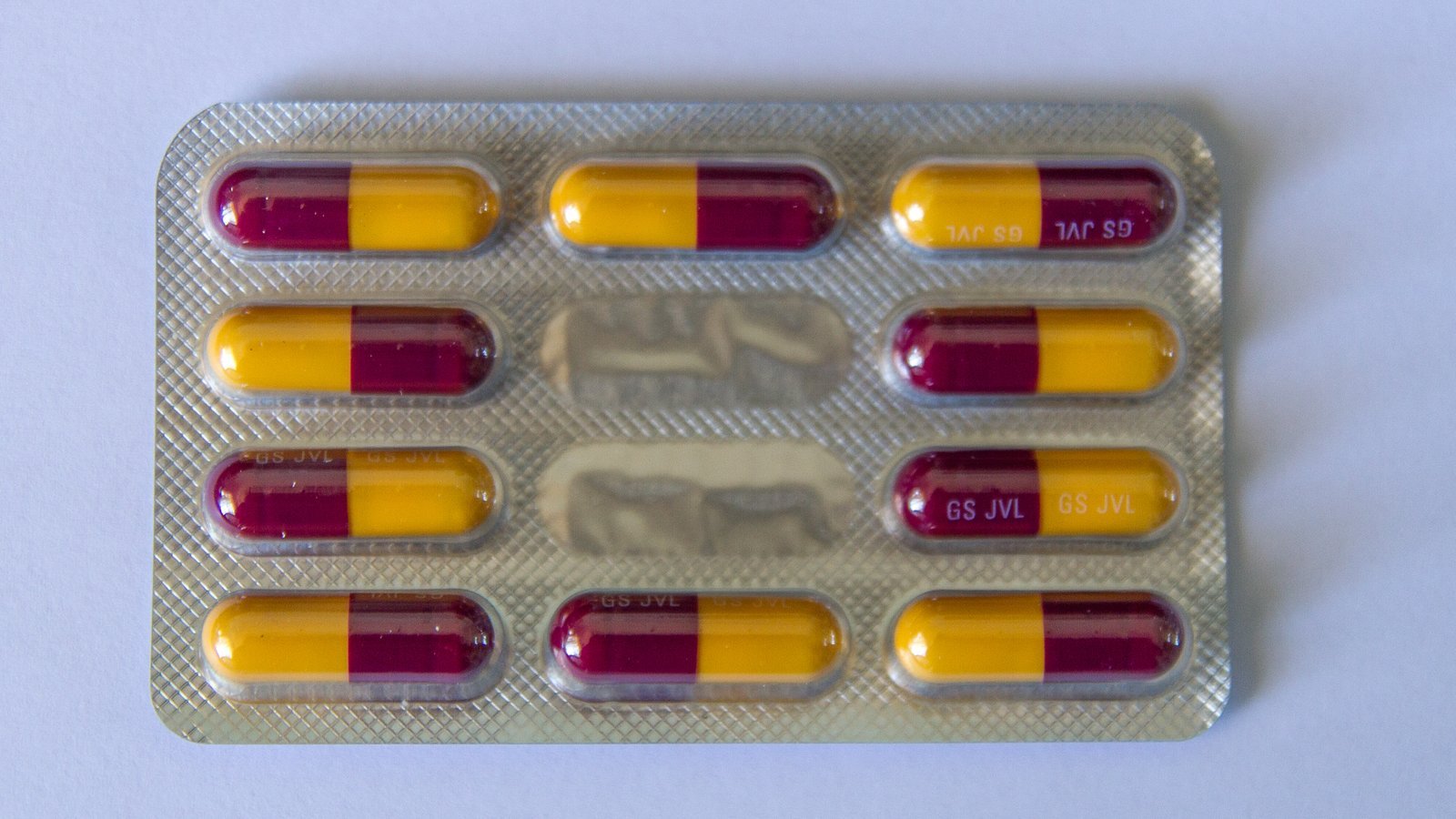
Cover image: "Blister of tablets" by Tarasna0922, via Wikimedia Commons, licensed CC BY-SA 4.0, cropped and resized.