
Executive Summary & Key Takeaways
- 1 Billion Euro Proposal: The IVCA is urging the Irish government to create a state-backed investment vehicle to unlock 1 billion to 2 billion euros in domestic pension and institutional funds for local startups.
- Reducing International Dependency: International venture capital currently accounts for approximately 75% of funding in Irish technology SMEs, leaving the ecosystem vulnerable to global macroeconomic shifts.
- French Tibi Benchmark: The IVCA advocates for a co-investment structure modeled after the successful French Tibi initiative, where institutional commitments are matched with private capital.
- Leadership Transition: The call comes alongside the election of Richard Watson (Managing Partner of Furthr VC) as the new IVCA Chairperson, succeeding Caroline Gaynor (Partner at Lightstone Ventures).
- Tax Incentives Reform: The association is also calling for critical revisions to the Employment Investment Incentive Scheme (EIIS) and Capital Gains Tax (CGT) relief to support early-stage investments.
In the lead-up to the national budget, the Irish Venture Capital and Private Equity Association (IVCA) has issued a significant policy proposal urging the Irish government to establish a new investment framework. The proposal calls for the creation of a state-backed fund-of-funds designed to unlock between 1 billion and 2 billion euros in domestic pension, insurance, and bank assets to support local technology startups and growing small-to-medium enterprises (SMEs).
The IVCA warns that Ireland\'s reliance on international venture capital, which currently finances approximately 75% of domestic tech startup activity, represents a major vulnerability. In the event of global economic contractions, international capital can withdraw rapidly, leaving local innovations unfunded. By mobilizing even a small fraction of Ireland\'s vast domestic pension assets, the country can build a self-sustaining financial cushion for its native technology sector.
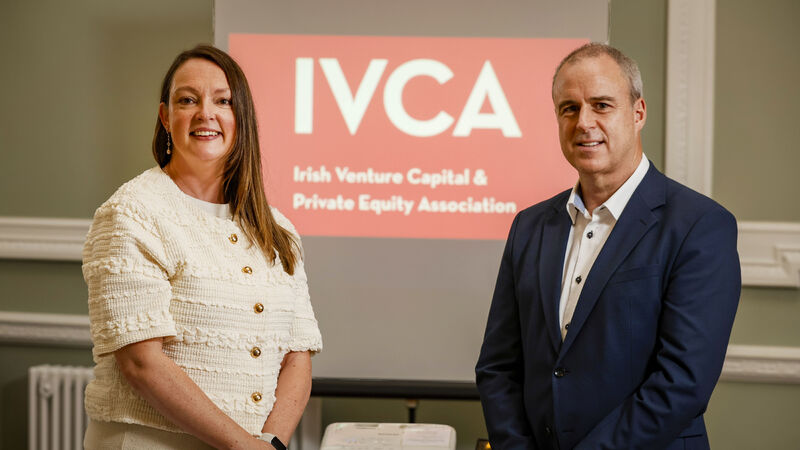
Sarah-Jane Larkin (Director General, IVCA) and Richard Watson (Chairperson, IVCA and Managing Partner of Furthr VC). Image credit: IVCA Website.
Mobilizing Domestic Pension Assets: The 1 Billion Euro Mandate
Ireland\'s domestic pension funds currently manage billions of euros in assets, yet less than 0.1% of these resources are allocated to domestic venture capital or private equity. The IVCA argues that this lack of domestic institutional investment is an anomaly compared to other European nations. The proposed fund-of-funds would aggregate capital from domestic pension schemes, retail banks, and commercial insurers, using state-backed co-investment guarantees to reduce risk.
The IVCA points to the **French Tibi Initiative** as the benchmark model for this proposal. Under the Tibi model, the French government secured commitments from institutional investors to allocate billions of euros to late-stage technology funds, matching these funds with private venture capital. Implementing a similar structure in Ireland would provide local venture capital managers with a reliable base of domestic capital, allowing them to lead larger funding rounds and support local startups through their scale-up phases without relying solely on foreign investors.
Addressing Ecosystem Vulnerability
According to IVCA market data, while venture capital funding for Irish tech firms has remained relatively stable in the range of 900 million to 1 billion euros annually, the heavy concentration of foreign capital is a persistent risk. International venture funds are highly sensitive to monetary policy changes, currency fluctuations, and geopolitical risks. If foreign investment declines, Irish startups—particularly in high-capital sectors like biotechnology, medical devices, and clean energy—face severe funding bottlenecks.
By establishing a domestic institutional funding stream, Ireland would protect its high-tech employment base. The IVCA emphasizes that tech startups are not only primary drivers of high-value job creation, but also key players in transitioning the state toward a digital, knowledge-based economy.
Reforming Early-Stage Funding Incentives
Beyond institutional fund mobilization, the IVCA\'s policy recommendations highlight several fiscal adjustments designed to stimulate early-stage seed and pre-seed investment:
- EIIS Restructuring: The Employment Investment Incentive Scheme (EIIS) should be simplified to reduce administrative burdens for angel investors and small companies. The IVCA advocates for tax-relief procedures to be streamlined, making it easier for retail investors to fund early-stage innovation.
- Capital Gains Tax (CGT) Relief: Reforming the CGT Entrepreneur Relief scheme is recommended to align Ireland\'s capital gains treatment with competitive international rates. Currently, the caps and criteria for relief are viewed as restrictive compared to the United Kingdom and other European tech hubs.
- R&D Tax Credit Acceleration: Speeding up the refund cycle for R&D tax credits is highlighted as a vital way to improve cash flow for pre-revenue biotechnology and software startups.
About the IVCA and Current Leadership
The **Irish Venture Capital and Private Equity Association (IVCA)** is the representative body for venture capital and private equity firms operating on the island of Ireland. Established to support the development of a venture-backed startup ecosystem, the IVCA represents the vast majority of professional investment managers in the country, whose portfolios fund hundreds of innovative SMEs and support thousands of jobs.
The association\'s leadership is composed of experienced industry professionals:
- Sarah-Jane Larkin, Director General: Sarah-Jane has led the IVCA as Director General since January 2018. Under her leadership, the association has expanded its policy advocacy, regularly liaising with government ministries, presenting at Oireachtas committees, and publishing detailed quarterly venture capital activity reports. Her LinkedIn profile and public policy briefs can be referenced via the official IVCA LinkedIn Page.
- Richard Watson, Chairperson: Elected as Chairperson in August 2026, Richard is the Managing Partner of Furthr VC, one of Ireland\'s active early-stage venture capital firms. He succeeded Caroline Gaynor (Partner at Lightstone Ventures), who successfully completed her chairperson term. Richard brings over two decades of technology investment experience to the role, focusing on guiding early-stage Irish software and life science companies.
For more updates on their campaign to unlock domestic capital, you can view the official IVCA LinkedIn Campaign Post.
Comparing Investment Frameworks
To highlight the structural differences between Ireland\'s current funding landscape and the changes advocated by the IVCA, the table below outlines the comparison between the current framework and the proposed reform:
| Structural Metric | Current Irish Funding Model | IVCA Proposed Reform Model |
|---|---|---|
| Primary Capital Source | International venture funds (accounts for approx. 75% of total capital). | Balanced mix of domestic institutional capital and international funds. |
| Domestic Pension Allocation | Less than 0.1% of national pension assets committed to local startups. | Targeted allocation of pension assets via a secure co-investment vehicle. |
| Ecosystem Stability | High exposure to international macroeconomic volatility. | Consistent domestic funding base ensuring long-term research and development. |
Frequently Asked Questions (FAQ)
Q1: What is the main objective of the IVCA\'s pre-budget submission?
The primary goal is to convince the government to establish a state-backed investment vehicle that will unlock domestic pension and institutional funds to invest in local startup companies.
Q2: What is the "French Tibi" initiative cited by the IVCA?
The Tibi initiative is a French policy success where major institutional investors committed billions of euros to technology funds, creating a massive pool of local late-stage venture capital. The IVCA wants to replicate this matching model in Ireland.
Q3: Who currently leads the IVCA?
The association is led by Sarah-Jane Larkin (Director General since 2018) and Richard Watson (elected Chairperson in August 2026, succeeding Caroline Gaynor).
Q4: How does the high share of foreign venture capital impact Irish startups?
With foreign investors providing 75% of funding, the Irish ecosystem is vulnerable to international capital contractions. Re-establishing domestic funding streams ensures funding continuity during global economic downturns.