
Executive Summary & Key Takeaways
- Surging Grid Demand: Data centers consumed approximately 23% of Ireland\'s total metered electricity in 2025, a figure projected to climb to 30% by 2032, placing unprecedented strain on the national grid.
- Nuclear Ban Reconsideration: The Irish government is keeping the door open to nuclear energy, debating the repeal of a long-standing ban on domestic nuclear fission established in 1999.
- Legislative Action: The Electricity Regulation (Removal of Nuclear Fission Prohibitions) Bill 2026 has been introduced to the Dail, aiming to allow the development of clean, low-carbon nuclear power.
- Shift in Public Opinion: Recent national polling reveals a major shift in public sentiment, with 43% of respondents supporting the removal of the nuclear ban, compared to 28% who favor retaining it.
- Baseload Stability: Proponents argue that Small Modular Reactors (SMRs) could provide a stable, zero-carbon baseload to complement intermittent wind and solar energy, securing Ireland\'s industrial competitiveness.
Ireland is facing a critical crossroads in its energy policy. Long celebrated as a premier global hub for multinational technology giants, the nation is grappling with the infrastructure consequences of its success. Surging electricity consumption from massive data center campuses has pushed the national grid to its absolute limits, forcing a fundamental reconsideration of Ireland\'s statutory ban on nuclear energy.
For over two decades, nuclear power has been legally prohibited in Ireland under the Electricity Regulation Act of 1999. However, as the country balances its ambitious decarbonization targets with the need to secure a stable energy supply for its digital economy, policymakers are signaling a willingness to keep the nuclear door open. The debate is gaining momentum with the introduction of new legislation aiming to repeal the ban and allow the exploration of modern nuclear technologies, such as Small Modular Reactors (SMRs).
The Data Center Energy Surge: Mapping the Grid Impact
According to the latest figures from EirGrid, the state-owned transmission system operator, data centers have become a dominant driver of electricity demand in Ireland. In 2025, data centers accounted for approximately 23% of the country\'s total metered electricity consumption. This represents a massive increase from less than 5% a decade ago, surpassing the total electricity consumed by all rural dwellings in Ireland combined.
The concentration of these data hubs, largely operated by hyper-scale cloud providers like Amazon, Microsoft, and Google, has led to a *de facto* moratorium on new grid connections in the Dublin region. The Commission for Regulation of Utilities (CRU) has shifted away from a first-come, first-served connection model, requiring data center developers to prove they can generate their own on-site power or offset their consumption with new renewable energy assets before securing a grid connection. By 2032, data centers are projected to consume at least **30% of Ireland\'s total power supply**, raising urgent questions about how to secure continuous, low-carbon baseload energy.
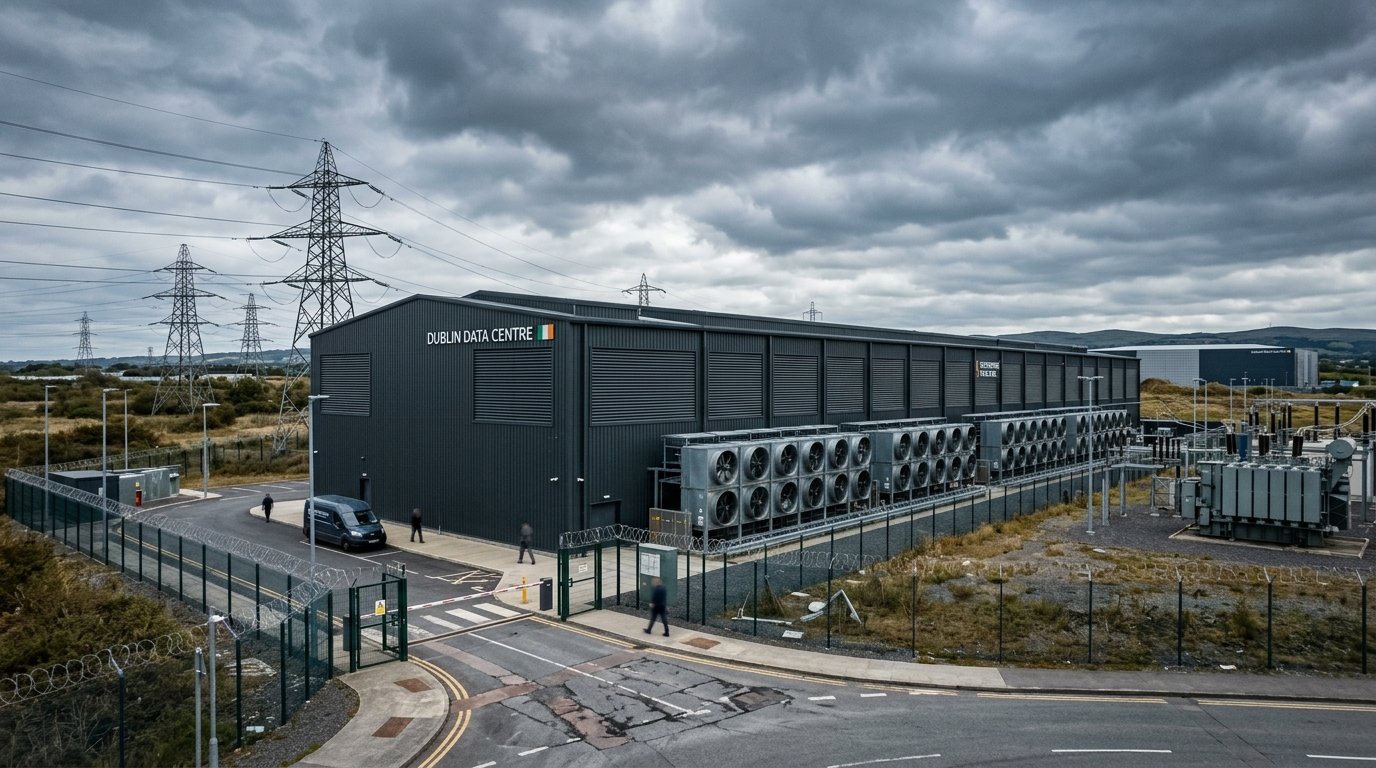
A hyper-scale data center facility in Dublin connected to high-voltage grid lines, highlighting the surging industrial electricity demand.
The Legislative Move to Repeal the 1999 Ban
In response to these grid challenges, legislative action is underway in the Dail (the Irish parliament). Fianna Fail TD James O\'Connor has introduced the **Electricity Regulation (Removal of Nuclear Fission Prohibitions) Bill 2026**. The bill seeks to repeal Section 18 of the 1999 Act, which currently prohibits the Commission for Regulation of Utilities from licensing any electricity generation station that utilizes nuclear fission.
Proponents of the bill argue that keeping the ban in place limits Ireland\'s future options for achieving net-zero emissions. While wind and solar power are expanding rapidly, their intermittency requires a reliable, zero-carbon baseload energy source to prevent grid collapse on windless or cloudy days. Currently, Ireland relies on gas-fired power stations to provide this stability. Introducing SMRs, which are factory-built, scaleable nuclear reactors, is increasingly viewed as a viable clean-energy alternative to fossil fuels.
Taoiseach Micheal Martin has publically stated that while the government remains focused on wind and solar development, Ireland must "keep its options open" regarding technological advancements in nuclear energy, particularly SMRs. The government is expected to publish a comprehensive energy white paper by the end of 2027, which will analyze the feasibility, cost, and safety profiles of modern nuclear generation.
Shifting Public Opinion and the Political Debate
The prospect of nuclear energy in Ireland, once politically unmentionable, is seeing a shift in public sentiment. Recent national polling shows that **43% of Irish respondents favor removing the nuclear ban** to secure energy independence and meet climate targets, while only 28% support retaining the prohibition. The remaining respondents indicated they were undecided, reflecting a growing public openness to exploring nuclear options.
However, the debate remains contentious. Environmental groups and some political factions argue that nuclear power is too slow and expensive to deploy compared to offshore wind and battery storage. Critics point out that designing, licensing, and constructing nuclear facilities, even SMRs, would take at least a decade, doing little to resolve the immediate grid pressures facing the country. They advocate instead for stricter limits on data center growth and a greater focus on green hydrogen and grid-scale battery systems.
Comparing Ireland\'s Baseload Energy Options
To summarize the options available to Irish policymakers to secure the country\'s baseload energy supply while meeting net-zero targets, the table below outlines the comparison between competing technologies:
| Energy Option | Carbon Profile | Grid Baseload Stability | Estimated Deployment Timeline |
|---|---|---|---|
| Gas-Fired Power (Current) | High emissions (fossil fuel reliance). | Excellent (highly dispatchable and reliable). | Immediate (active infrastructure). |
| Small Modular Reactors (SMRs) | Zero carbon emissions during operation. | Excellent (continuous, weather-independent baseload). | 8 to 12 years (requires legislative repeal first). |
| Offshore Wind + Battery Storage | Zero carbon emissions during operation. | Moderate (intermittent, dependent on weather and storage capacity). | 3 to 6 years (active development pipeline). |
Frequently Asked Questions (FAQ)
Q1: Why is Ireland considering nuclear energy after banning it in 1999?
The reconsideration is driven by a massive surge in electricity demand from data centers, which now consume 23% of the country\'s total metered electricity. Nuclear energy is being explored to provide a stable, zero-carbon baseload power source.
Q2: What is the Electricity Regulation Bill 2026?
Introduced by TD James O\'Connor, this bill proposes to remove the statutory ban on domestic nuclear fission, allowing the regulatory body to explore licensing clean nuclear power options in the future.
Q3: What are Small Modular Reactors (SMRs)?
SMRs are advanced nuclear reactors that have a power capacity of up to 300 MW per unit. They are smaller, safer, and more flexible to deploy than traditional large-scale nuclear power plants.
Q4: How does public opinion view nuclear power in Ireland?
Public sentiment has shifted significantly, with 43% of the population supporting the repeal of the nuclear ban to ensure energy security, while 28% prefer to retain the ban.