

Executive Summary & Key Takeaways
- CSO Export Contraction: Ireland\'s goods exports fell by 35 percent (€8.7 billion) year-on-year in early 2026, driven primarily by a steep 61 percent decline in medical and pharmaceutical product exports.
- The Stockpiling Effect: The sharp drop represents a normalization of trade flows following an intense period of "frontloading" in late 2025, where global drug developers stockpiled inventory in the United States ahead of proposed tariff changes.
- Macroeconomic Impact: The contraction in pharmaceutical exports led directly to a temporary decline in Ireland\'s quarterly Gross Domestic Product (GDP) during Q1 2026, highlighting the economy\'s reliance on multinational corporate earnings.
- Long-Term Fundamentals: Despite the volatility in headline trade data, underlying global demand for Irish-manufactured GLP-1 weight loss therapies and advanced biologics remains robust, with capital investments in Limerick and Cork proceeding as scheduled.
Recent trade data released by the Central Statistics Office (CSO) of Ireland has sparked an intensive discussion regarding the structure and volatility of the nation\'s export-driven economy. In early 2026, headline figures revealed a sharp contraction in total goods exports, led by a dramatic decline in the medical and pharmaceutical sector. Specifically, medical and pharmaceutical product exports—which typically anchor the country\'s trade surplus—plummeted by 61 percent in the early months of the year, dragging down overall national export values by 35 percent (€8.7 billion) year-on-year.
While some commentators have interpreted these figures as a warning sign for Ireland\'s industrial competitiveness, macroeconomic analysts and trade historians point to a more complex, structural explanation. Rather than indicating a decline in global demand or a loss of manufacturing competitiveness, the 2026 figures represent the unwinding of an extraordinary, tariff-preemptive stockpiling surge that occurred throughout the latter half of 2025.
The Stockpiling Phenomenon: Frontrunning Transatlantic Tariffs
The roots of the 2026 export decline lie in the shifting international trade landscape of late 2025. Facing the prospect of a new U.S. administration and proposed universal tariffs on imported goods, multinational pharmaceutical companies operating in Ireland executed a massive supply chain adjustment. U.S.-headquartered corporations, which dominate the local manufacturing base, aggressively accelerated the shipment of active pharmaceutical ingredients (APIs) and finished drug products from their Irish facilities directly to distribution hubs in the United States.
This process of "frontloading" allowed companies to secure vast inventories of vital therapeutics within U.S. borders before any potential tariff regimes could be enacted. The result was a historic, record-breaking surge in Irish export data during late 2025, with pharmaceutical shipments reaching unprecedented highs. However, once U.S. warehouses were fully stocked and the immediate threat of trade disruptions was navigated, the pace of exports naturally returned to normal levels. The steep year-on-year decline recorded in early 2026 is, therefore, a mathematical correction against the artificial, tariff-induced spike of the previous year.
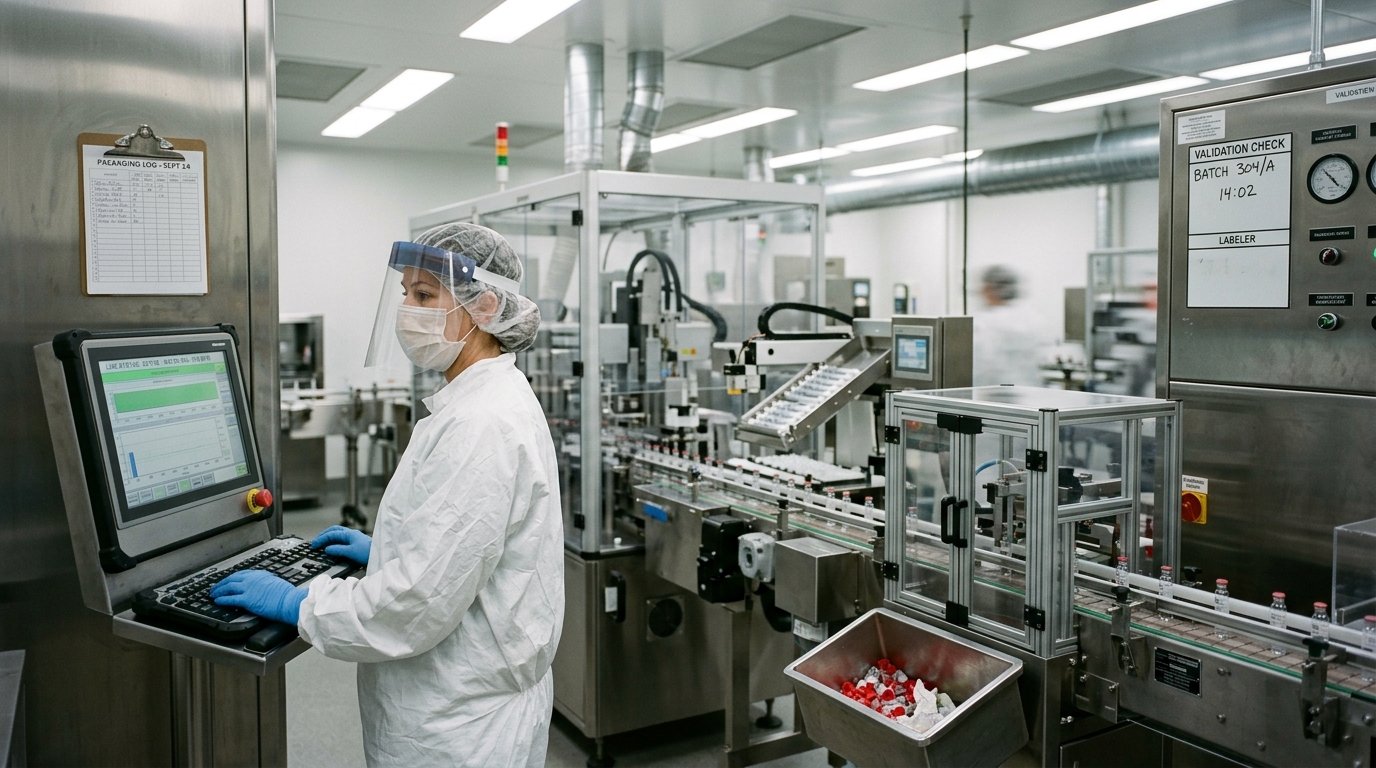
A sterile packaging line inside an Irish biomanufacturing facility. Image credit: Priya Life Science News Archive
Comparative CSO Trade Statistics: Understanding the Shift
To contextualize the scale of this correction, the table below outlines key CSO trade data comparisons, showing the transition from the stockpiling peak to the early 2026 normalization:
| Metric | Late 2025 (Stockpiling Peak) | Early 2026 (Correction Period) | Primary Driver |
|---|---|---|---|
| Total Goods Exports | Record highs, driven by biopharma expansion | Contraction of 35 percent (€8.7 billion decline) | Unwinding of pre-tariff stockpiles |
| Pharma & Med Exports | Massive volume acceleration to U.S. hubs | 61 percent year-on-year drop | Normalization of U.S. import pipelines |
| Ireland GDP Growth | Artificially inflated by contract manufacturing revenue | Significant Q1 contraction in national accounts | Shift in multinational transfer pricing & shipments |
| U.S. Share of Exports | Reached historic peak concentration | Noticeable decline in transatlantic share | Inventory adjustments in U.S. logistics nodes |
The GLP-1 Factor: Ireland as the Global Weight Loss Hub
Central to this export dynamic is Ireland\'s unique position in the production of blockbuster GLP-1 receptor agonists used for diabetes and obesity management. Blockbuster therapies like semaglutide and tirzepatide rely heavily on active ingredients, formulation services, and sterile fill-finish operations located within the Irish Republic.
Eli Lilly\'s extensive presence in Kinsale and its ongoing investment in a state-of-the-art €1 billion manufacturing campus in Limerick highlight the country\'s role as a production hub. Similarly, other global giants have expanded their capacity in Cork, Athlone, and Dublin to keep pace with the surging global demand for weight loss therapies. Because these high-value therapeutics command significant market share globally, even a minor alteration in their shipping schedules can cause visible shifts in Ireland\'s national trade accounts.
Although the headline CSO data showed a sharp correction in exports, the actual demand for GLP-1 therapies remains at an all-time high, with supply constraints persisting in several key markets. This mismatch confirms that the decline is a temporary logistical correction rather than a reduction in manufacturing relevance.
Macroeconomic Vulnerability: The "Leprechaun Economics" Debate
The sharp swing from the record-breaking export highs of 2025 to the steep decline in Q1 2026 has revived the debate regarding Ireland\'s macroeconomic metrics. Known in international finance as "Leprechaun Economics," the volatility in Irish GDP highlights the distortion caused by a small number of massive multinational corporations.
Because these companies use contract manufacturing and intellectual property structures based in Dublin and Cork, their internal corporate decisions—such as moving intellectual property or frontloading physical inventory to bypass tariffs—can cause swings in national accounts that do not reflect the domestic economy\'s reality. The Central Bank of Ireland has repeatedly urged policy makers to focus on Modified Domestic Demand (MDD) rather than GDP to gauge the health of local employment, consumer spending, and domestic business activity, which have shown steady growth despite the export volatility.
Outlook: Diversification and Structural Strength
Looking ahead through the remainder of 2026, analysts expect a gradual stabilization of pharmaceutical exports as stockpiled inventories in the United States are utilized and regular supply patterns resume. Additionally, Irish exporters are showing signs of market diversification, with increased shipments to Great Britain and other European Union partners helping to offset the volatility of U.S. trade routes.
Furthermore, the long-term fundamentals of the Irish pharmaceutical cluster remain secure. The infrastructure, skilled workforce, and regulatory alignment with both the FDA and EMA continue to attract high-value biopharmaceutical investments, ensuring that Ireland will remain a key node in the global healthcare supply chain.
Frequently Asked Questions
Why did Ireland\'s pharmaceutical exports fall in early 2026?
The decline was primarily a correction following a massive period of pre-emptive stockpiling (or "frontloading") in late 2025. Pharmaceutical companies shipped large quantities of inventory to the United States to secure products before any potential new tariff policies were implemented.
Which weight loss drugs are manufactured in Ireland?
Ireland serves as a major manufacturing hub for blockbuster GLP-1 receptor agonists used to treat obesity and type 2 diabetes, including active ingredients and sterile packaging processes for leading pharmaceutical developers.
What is "frontloading" in supply chain management?
Frontloading refers to the practice of accelerating shipments and building up inventories in a destination market ahead of expected supply chain disruptions, regulatory changes, or the implementation of trade tariffs.
How does pharmaceutical export volatility affect Ireland\'s GDP?
Because the pharmaceutical sector represents a large share of Ireland\'s industrial output, swings in the shipping schedules and corporate revenue of multinational drug developers can cause significant volatility in national GDP, even when the domestic economy remains stable.
What is Modified Domestic Demand (MDD)?
Modified Domestic Demand is an economic metric used in Ireland that excludes the distorting effects of intellectual property transfers and aircraft leasing by multinational corporations, providing a clearer view of domestic economic activity.