
In a historic move that significantly strengthens Europe’s advanced technology infrastructure, Intel has officially announced a massive €5 billion ($5.7 billion) capital investment at its state-of-the-art semiconductor campus in Leixlip, County Kildare. Driven by the unprecedented global surge in demand for artificial intelligence (AI) applications, high-performance computing, and resilient silicon supply chains, this monumental capital commitment represents one of the largest single foreign direct investments in Ireland’s history. The expansion is designed to upgrade Intel’s existing fabrication facilities and install next-generation manufacturing systems to scale production of the new Intel Xeon 6 processors and next-generation Xeon chips built on the advanced Intel 3 process node.
The announcement was welcomed by Tánaiste and Irish government leader Micheál Martin, TD, who attended the official launch at the Leixlip facility. Addressing gathered industry leaders, government ministers, and Intel executives, Martin described the €5 billion investment as a "powerful vote of confidence in Ireland's economy, its business ecosystem, and, most importantly, its highly skilled workforce." The Tánaiste emphasized that this commitment is not an isolated success but rather a reflection of the deep-rooted strength of Ireland’s technology sector, which now comprises roughly 130 global companies and employs over 30,000 workers across the country.
Strategic Technology Focus: The Intel 3 Node and Xeon 6
The core of Intel's new investment centers on the rapid scaling of the Intel 3 process node. In the highly competitive world of semiconductor manufacturing, the Intel 3 node represents a crucial technological milestone. By utilizing Extreme Ultraviolet (EUV) lithography and advanced FinFET transistor architectures, the Intel 3 node delivers significant improvements in transistor density, performance-per-watt, and power efficiency compared to previous manufacturing generations.
This upgraded facility will serve as the primary manufacturing hub for Intel's Xeon 6 processors. These advanced microprocessors are engineered specifically to handle the massive workloads of modern data centers, including large language models (LLMs), deep learning training, and complex data analytics. By manufacturing these chips locally in Leixlip, Intel Foundry is positioned to provide its European and global customers with a secure, geographically diverse supply of high-performance AI silicon, reducing the continent's reliance on East Asian manufacturing hubs and aligning with the strategic goals of the European Chips Act.
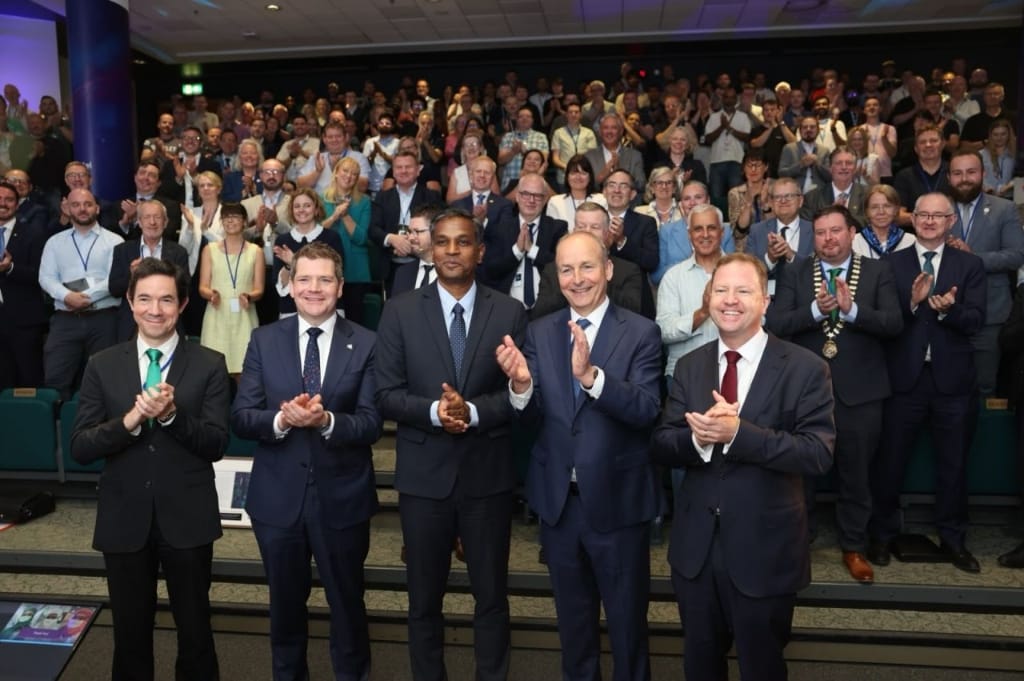
From left: Minister Peter Burke, Minister James Lawless, Intel Foundry Head Naga Chandrasekaran, Tánaiste Micheál Martin, and IDA Ireland CEO Michael Lohan during the press conference.
Strengthening the Global Supply Chain: Intel Foundry's Vision
Naga Chandrasekaran, Intel’s Executive Vice President, Chief Technology and Operations Officer, and General Manager of Intel Foundry, traveled to Ireland to announce the investment. In his address, Chandrasekaran highlighted the Leixlip campus's pivotal role in Intel's global foundry strategy. "This investment is a definitive commitment to maximizing our manufacturing capacity in Europe," Chandrasekaran stated. "By upgrading Leixlip to our most advanced process technologies, we are creating a resilient, geographically balanced supply chain that meets the critical needs of our global customers in the AI era."
The announcement also featured prominent representation from Ireland's industrial and educational leadership. Michael Lohan, CEO of IDA Ireland-the national agency responsible for attracting foreign investment-stressed that the expansion secures Ireland’s position as a premier global hub for advanced manufacturing. James Lawless, TD, Minister for Further and Higher Education, Research, Innovation and Science (and the local constituency TD for Kildare North), noted that the project will foster deep partnerships between Intel and Irish universities, driving research in engineering, physics, and computer science to supply the talent pipeline required for future semiconductor breakthroughs.
Economic Impact: Job Creation and Construction Boom
Beyond its technological significance, the €5 billion investment will deliver a substantial boost to the Irish economy. Intel’s Leixlip campus currently employs approximately 4,900 people in highly skilled roles. The new expansion project is expected to create "several hundred" new permanent, high-tech positions within Intel, spanning engineering, quality assurance, facility management, and logistics.
Furthermore, the physical construction and equipment installation phase-planned to run through the end of 2027-will support thousands of temporary jobs for specialized tradespeople, including mechanical and electrical engineers, pipefitters, and construction specialists. This phase represents a massive injection of capital into the local Kildare economy, benefiting hospitality, retail, and service providers across the region.
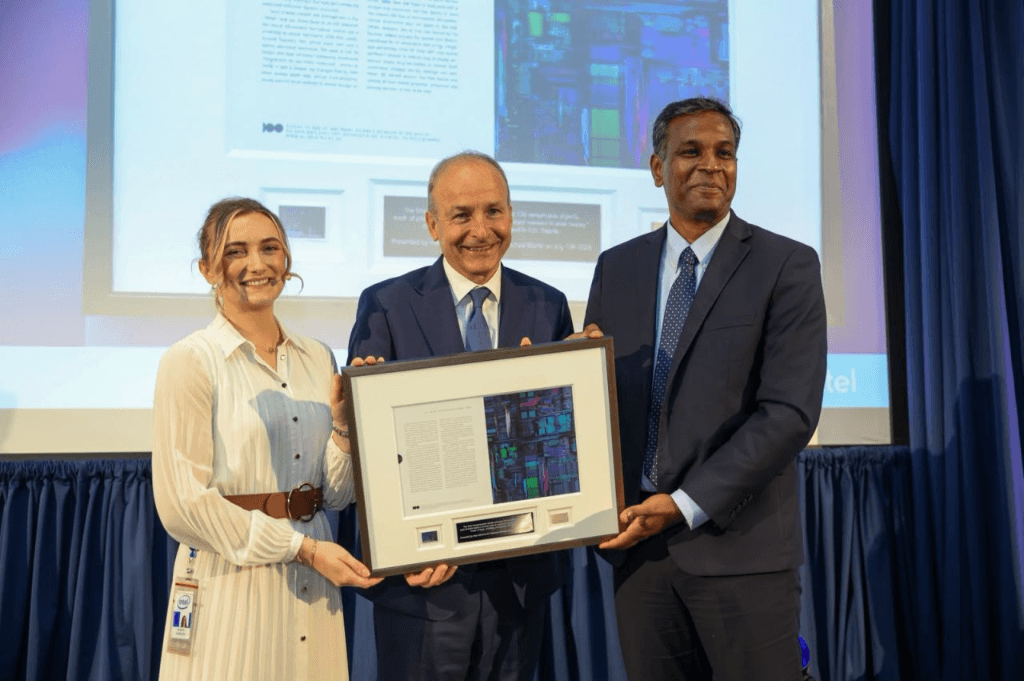
Tánaiste Micheál Martin and Intel's Naga Chandrasekaran present a framed Pentium microprocessor display, celebrating Ireland's tech history.
Celebrating History: The Intel Microprocessor in Irish Culture
During the event, a ceremonial presentation highlighted the historic relationship between Intel and Ireland. Tánaiste Micheál Martin and Naga Chandrasekaran held a framed display featuring the Intel Pentium microprocessor, representing the historic inclusion of the chip as Object #100 in the celebrated project "A History of Ireland in 100 Objects" by Fintan O'Toole.
First launched in 1994, the Pentium chip manufactured at Leixlip represented over half of the world's Pentium supply at the time. By placing the silicon chip alongside ancient Irish artifacts such as the Tara Torc and the Book of Kells, historians and cultural leaders recognized the profound impact of high-tech manufacturing in reshaping modern Ireland. This presentation served as a reminder of how Intel's arrival in 1989 catalyzed Ireland's transformation from an agricultural economy into the globalized, technology-driven powerhouse it is today.
Navigating Energy and Competitive Challenges
While celebrating the milestone, Tánaiste Micheál Martin acknowledged that maintaining Ireland’s competitiveness requires continuous government support, particularly in addressing high energy costs. These costs have been exacerbated by international conflicts, placing pressure on energy-intensive industrial facilities. Martin assured the industry that the government is committed to expanding national grid capacity, transitioning to renewable offshore wind energy, and providing robust Research and Development (R&D) tax incentives to ensure that Ireland remains an attractive destination for future semiconductor expansions.
The €5 billion expansion project is already underway, with the majority of the equipment installations and cleanroom upgrades scheduled to be completed by late 2027. The project solidifies Intel's presence in Kildare and establishes the Leixlip site as a crucial pillar in Europe's digital sovereignty and the global AI economy.
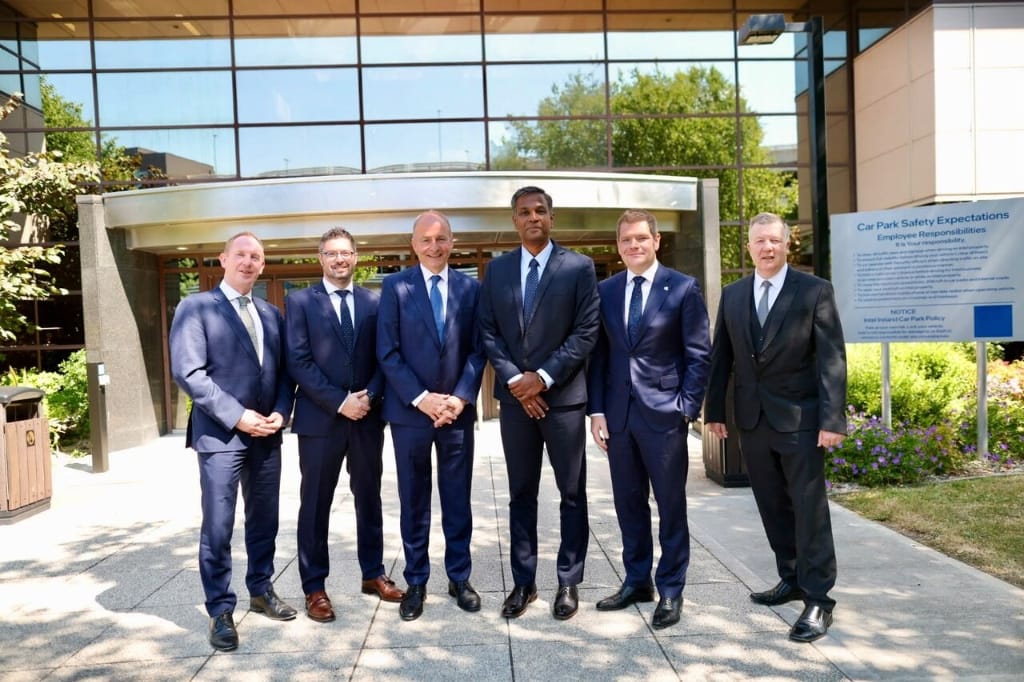
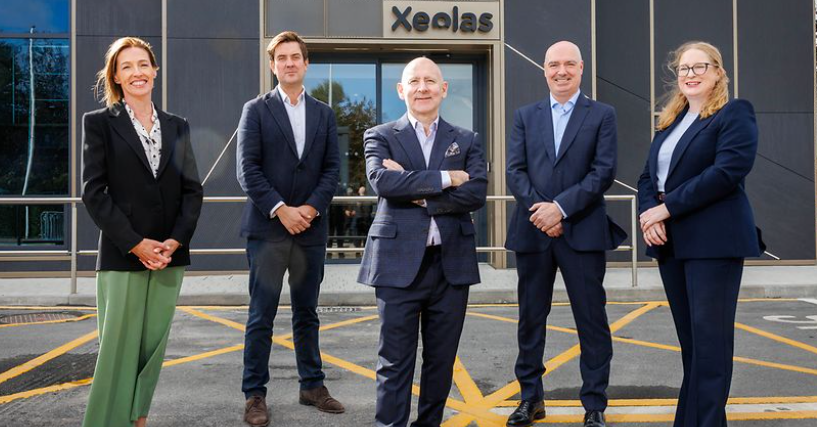
Irish government ministers and Intel executives gather outside the Intel Leixlip campus entrance in County Kildare.