
In sterile pharmaceutical manufacturing, the control of airborne particulate contamination is paramount to ensuring patient safety. A cleanroom is a highly engineered environment where the concentration of airborne particles is controlled, monitored, and maintained within strict regulatory limits. This article reviews the fundamental standards governing cleanroom classification under ISO 14644-1 and European Union GMP standards.
ISO 14644-1 Classification Classes
The International Organization for Standardization (ISO) defines cleanroom cleanliness based on the maximum allowable concentration of particles per cubic meter of air. Under ISO 14644-1, classifications range from ISO 1 (the cleanest) to ISO 9. In commercial pharmaceutical operations, cleanrooms are typically classified between ISO 5 and ISO 8 in operational state, depending on the criticality of the processes performed within them.
EU GMP Grades: A, B, C, and D
While ISO classification is based solely on particle counts, EU GMP Annex 1 translates these limits into operational grades based on the specific manufacturing tasks:
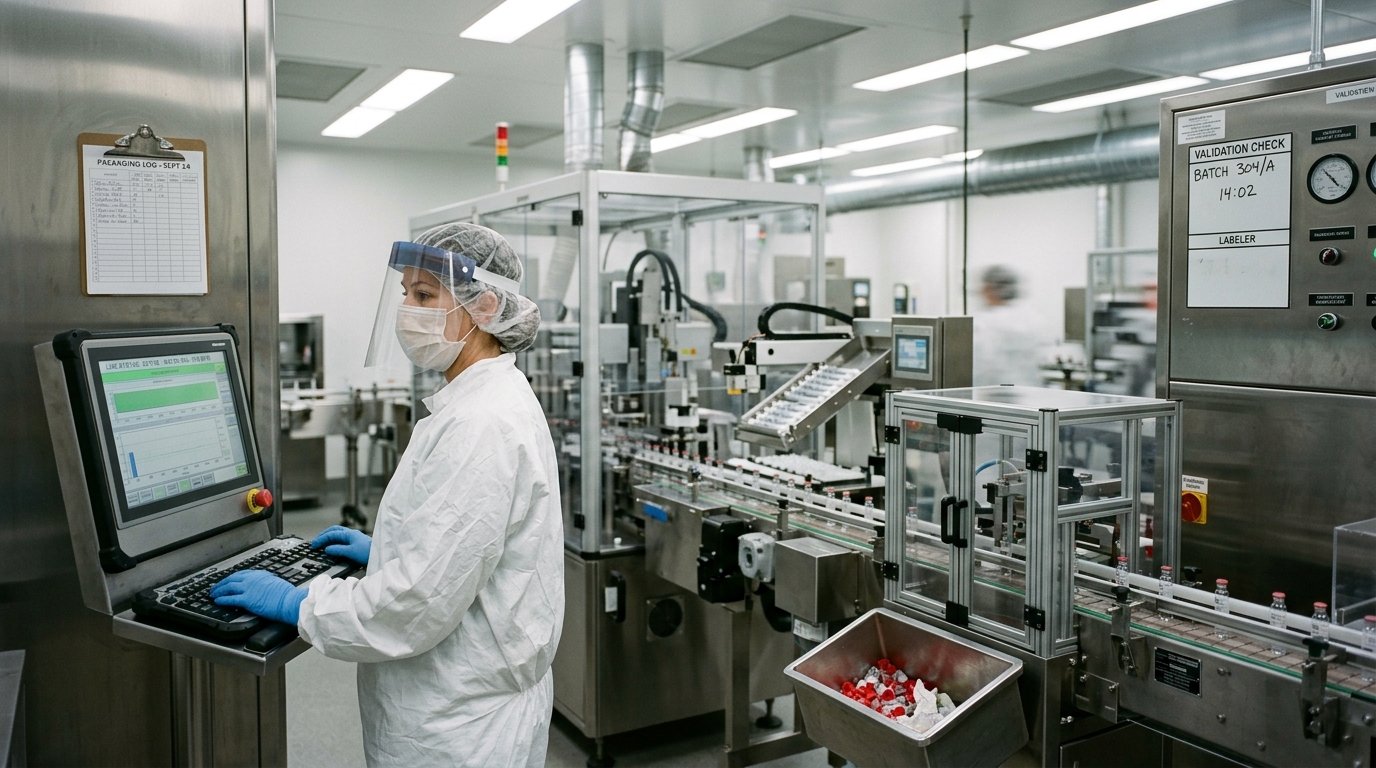
- Grade A: The local zone for high-risk operations, such as aseptic filling and compounding. It requires a laminar airflow system to maintain clean air sweeps, equivalent to an ISO 5 environment.
- Grade B: The background environment for the Grade A zone, also equivalent to ISO 5 in an "at-rest" state.
- Grade C: Used for less critical steps, such as preparation of solutions to be filtered, equivalent to ISO 7.
- Grade D: Used for handling components after washing and early-stage formulation prep, equivalent to ISO 8.
Airflow Dynamics: Laminar vs. Turbulent Flow
Maintaining cleanroom classification requires distinct airflow strategies. Grade A zones rely on **laminar (unidirectional) airflow**, where clean, HEPA-filtered air travels in parallel lines at a constant velocity, sweeping particles away from the critical work zone. In contrast, Grade C and D zones typically utilize **turbulent (non-unidirectional) airflow**, relying on dilution and rapid air changes to maintain cleanliness.
Understanding ISO 14644-1 Classes and Limits
Cleanrooms are controlled environments used in sterile pharmaceutical and medical device manufacturing to prevent contamination from airborne particles and microorganisms. The international standard for cleanroom design and classification is ISO 14644-1, which specifies the maximum allowable concentration of particles per cubic meter of air, ranging from ISO Class 1 (cleanest) to ISO Class 9 (least clean). In pharmaceutical manufacturing, the key classes are ISO Class 5, 7, and 8.
ISO Class 5 corresponds to EU GMP Grade A, the zone where high-risk aseptic operations (such as filling sterile vials or handling exposed products) are performed. The particle limit for ISO Class 5 is strictly capped at 3,520 particles/m³ for particles ≥0.5µm. ISO Class 7 corresponds to EU GMP Grade B (the background environment for Grade A), while ISO Class 8 corresponds to Grades C and D, used for less critical tasks like preparation of solutions and packaging.
Validation and Environmental Monitoring
Classification is verified through formal cleanroom validation, which involves measuring airborne particle counts, airflow velocity, pressure differentials between rooms, temperature, and relative humidity. Validation must be performed under three states: "as-built" (empty facility), "at-rest" (equipment installed but no personnel present), and "operational" (facility running with staff working). Continuous environmental monitoring (EM) is required during manufacturing runs to prove that the cleanroom consistently maintains its classified status.
Frequently Asked Questions
What is the difference between ISO 14644-1 and EU GMP cleanroom grades?
ISO 14644-1 is a global standard based solely on physical airborne particle counts. EU GMP cleanroom grades (A, B, C, D) are specific to pharmaceutical manufacturing and include limits for both airborne particles and microbiological contaminants (viable organisms).
How often must a cleanroom undergo formal ISO classification validation?
For ISO Class 5 cleanrooms, validation must be performed at least every 6 months. For ISO Class 6 and below, validation is required every 12 months, or immediately following any major modifications to the HVAC system.
What are pressure differentials in cleanroom design?
Pressure differentials are used to maintain a positive pressure in cleaner rooms compared to adjacent less-clean rooms. This ensures that air flows out of the cleanroom, preventing contaminants from entering when doors are opened.
Frequently Asked Questions
What is the difference between ISO 14644-1 and EU GMP Annex 1?
ISO 14644-1 is a global standard for cleanroom particle concentration classification. EU GMP Annex 1 is a regulatory document specifying GMP rules for sterile drug manufacturing, incorporating ISO classes.
How is a cleanroom classified for sterile liquid filling?
Sterile filling lines require an ISO Class 5 (Grade A) environment for the critical filling zone, surrounded by an ISO Class 7 (Grade B) background environment.
What is the difference between 'at-rest' and 'operational' states?
'At-rest' is when the cleanroom is running but empty of personnel. 'Operational' is when the cleanroom is running with operators present, representing the maximum particle load.
Frequently Asked Questions
What is the difference between ISO 14644-1 and EU GMP Annex 1?
ISO 14644-1 is a global standard for cleanroom particle concentration classification. EU GMP Annex 1 is a regulatory document specifying GMP rules for sterile drug manufacturing, incorporating ISO classes.
How is a cleanroom classified for sterile liquid filling?
Sterile filling lines require an ISO Class 5 (Grade A) environment for the critical filling zone, surrounded by an ISO Class 7 (Grade B) background environment.
What is the difference between 'at-rest' and 'operational' states?
'At-rest' is when the cleanroom is running but empty of personnel. 'Operational' is when the cleanroom is running with operators present, representing the maximum particle load.